PRJ-01 · UCSC ECE 218 Mechatronics
IR tracking, motion and projectile mechanics, power distribution
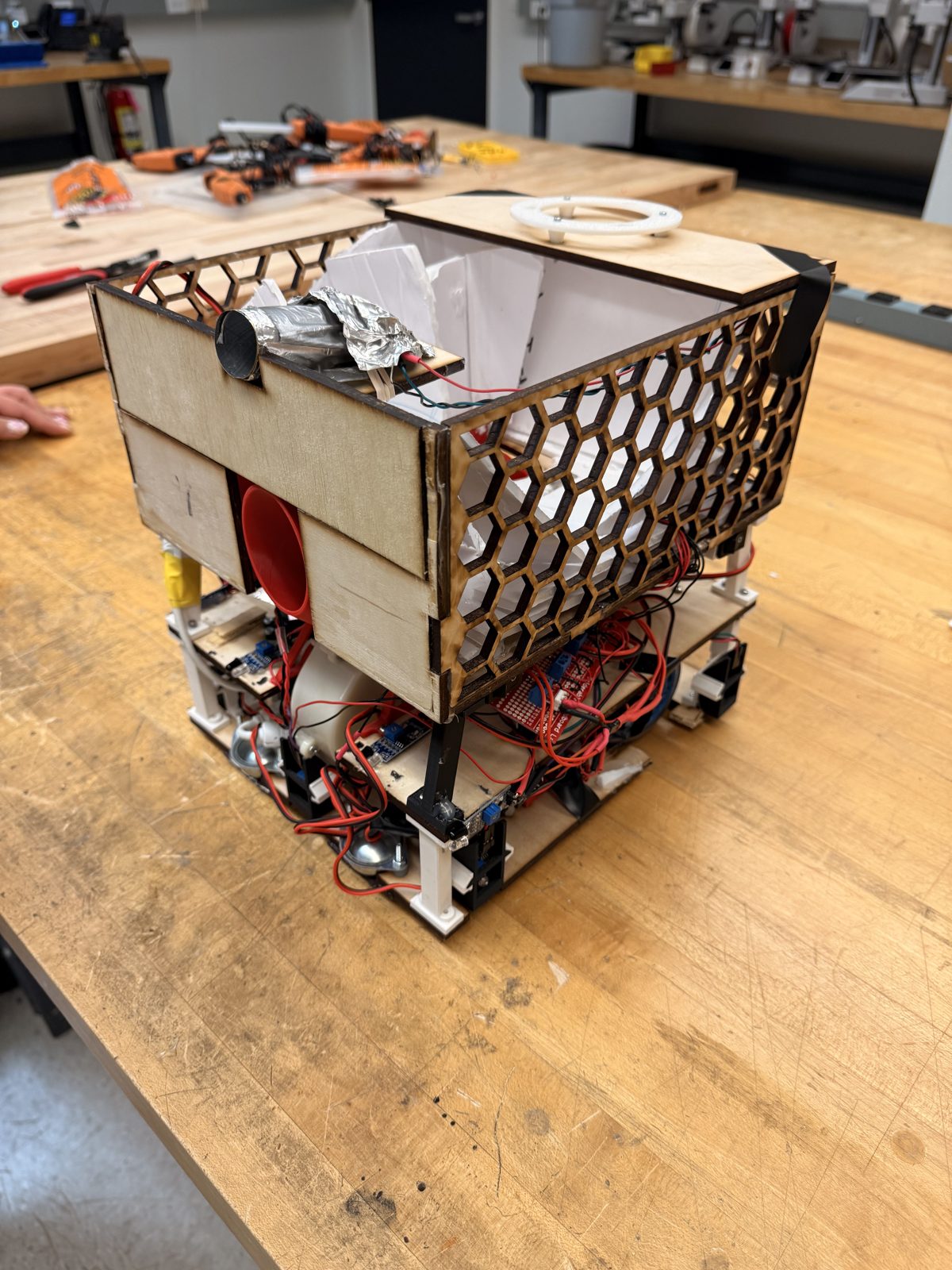
Outcome: Designed and integrated a fully autonomous ping-pong ball launching robot that navigated a 4 x 8 ft field, detected obstacles, located a 2 kHz IR beacon, entered the shooting zone, and repeatedly fired on target. I focused on the mechanical design, sensing electronics, power distribution, and hardware integration required to turn the individual subsystems into a working robot.
What I Did
- Designed the robot chassis, dual-layer mechanical layout, wheel mounts, sensor mounts, launcher integration, and ball storage system.
- Designed and soldered sensing electronics including the 2 kHz IR beacon detector and 25 kHz trackwire detection circuitry.
- Developed and rebuilt the multi-rail power distribution system supplying 9.9 V, 5 V, and 3.3 V subsystems after identifying regulator current limitations.
- Integrated the drivetrain, DS3658 flywheel driver, servo loading mechanism, sensors, wiring, and control hardware through repeated testing and redesign.
Motivation
The ECE 118 challenge was to design and build an autonomous robot capable of navigating a 4 x 8 ft competition field, avoiding obstacles, locating an opposing robot through an IR beacon, and launching ping-pong balls at the target. The robot had to operate autonomously within a 2-minute match, fit inside an 11 x 11 x 11 in size limit, and remain within a $150 material budget.
Results
The final robot could autonomously navigate the field, detect and avoid obstacles, locate the opponent's IR beacon, enter the ISZ, and repeatedly launch ping-pong balls. The final design evolved significantly through testing: the original geared shooter was replaced by a direct flywheel system, the rotating loader became a servo-controlled sliding gate, the power system was rebuilt multiple times, and anti-jam mechanical and software routines were added. The most important result was demonstrating that subsystem integration, rather than any individual circuit or mechanism, determined the overall reliability of the robot.
Technical Details
The sensing system combined a 2 kHz IR beacon detector with active bandpass filtering and a 25 kHz resonant trackwire detector for obstacle sensing. Four phototransistors fed the beacon detector, followed by multiple filter and adjustable gain stages before the signal was evaluated by the controller. Obstacle sensing used resonant tank circuits, amplification, peak detection, EMA filtering, hysteresis thresholds, and later forward-facing IR sensors after the trackwire circuit was damaged. The mechanical system used a fixed 45° flywheel launcher, a servo-controlled sliding ball gate capable of firing approximately once every 2 seconds, and a dual-layer chassis with removable sensor mounts.
Full Report (35 pages)
Full written report covering mechanical design, sensing circuits, power distribution, software architecture, testing, failures, and final design iterations.
Open PDF →- Role
- Mechanical design & electrical integration
- Team
- 3 students
- Timeline
- 5 weeks
- Context
- UCSC Mechatronics
- Tools
- C, MPLAB X, Uno32, soldering, laser cutting, 3D printing
- Skills
- Circuit design · Analog sensing · Power distribution · Motor control · Rapid prototyping